
Risography
Some basic background information, guidelines and notes specific to our studio, plus helpful tips + tricks to help you prepare your project for riso printing.
Introduction to Riso
-
Risograph printing is a stencil-based printing process that sits somewhere between screen printing and photocopying. Riso printing was developed in the 1980s by the Japanese company Riso Kagaku Corporation. Originally designed as a fast, low-cost solution for schools, churches, and offices, the machine functioned as a high-volume duplicator.
Designers and artists became drawn to its bold spot colors, matte finish, and the unpredictable charm created by layering inks one pass at a time, creating beautifully imperfect results. The medium works best for editions between 50 & 500 copies. -
A risograph printer uses stencils to print single colors, layered to create a multi-color print. For each color in a design, the machine creates a separate “master stencil” by burning a grayscale artwork onto a thin sheet of rice paper. That stencil wraps around a rotating ink drum filled with soy-based ink.
As paper feeds through the machine, ink is pushed through the stencil onto the page, one color at a time. To print multiple colors, the paper is fed through the machine multiple times, switching out ink drums between passes. We have a 2-color machine, meaning 2 colors can be printed with one single pass through the riso machine. -
Riso printing is great for projects printed in quantities between 50-500 copies (the more copies, the more economical it can be). Projects that include a textural, handmade feel, bright pops of color, and bold graphics, text, or illustration are perfect for riso printing. 11”x17” is the largest sheet size we can use, so some common formats include posters, zines, books, cards, mailers, handbills, event programs, schedules, or maps.
Things that don’t work well with riso:projects with tiny details that need perfect registration or sharp resolution
projects on glossy paper; we only use uncoated (matte) papers
projects that must be perfect!
Imperfections & Riso Quirks
Because riso printing is a hands-on method of printing that involves oil-based inks, variation between prints should be expected. These characteristics are inherent to the process and not considered defects.
Roller Marks: Faint lines or tracks can appear as paper moves through the machine’s feed rollers. This usually happens when printing with 3 or more colors, and with heavy ink coverage.
Misregistration: Slight shifts in alignment between color layers. Because each color is printed separately, tiny movements in the paper can cause layers to appear slightly off, creating unexpected gaps or overlaps between colors.
Smudges: Riso ink is an oil-based formula, meaning it also takes more time to dry in comparison to digital ink-jet or laser prints. Smudging happens the most in areas with heavy ink coverage, and around areas that are touched the most (i.e. book covers, event programs).
Uneven Ink Coverage: Uneven ink texture, due to large areas of printing, or large flats of color. This happens because ink is pushed through a stencil rather than fused digitally.
Misregistration
Roller Marks
Smudges/Texture
Ink Colors
Riso inks are soy-based, not heat-set. Unlike digital or laser printing, the ink is not fused to the paper, rather it sits on the surface and absorbs naturally. Because of this, drying time is slower. Prints can feel dry to the touch within a few hours, but full curing may take 24-48 hours, depending on ink coverage, paper stock, humidity, and layering. Since riso inks are transparent, they print best on light colored paper.
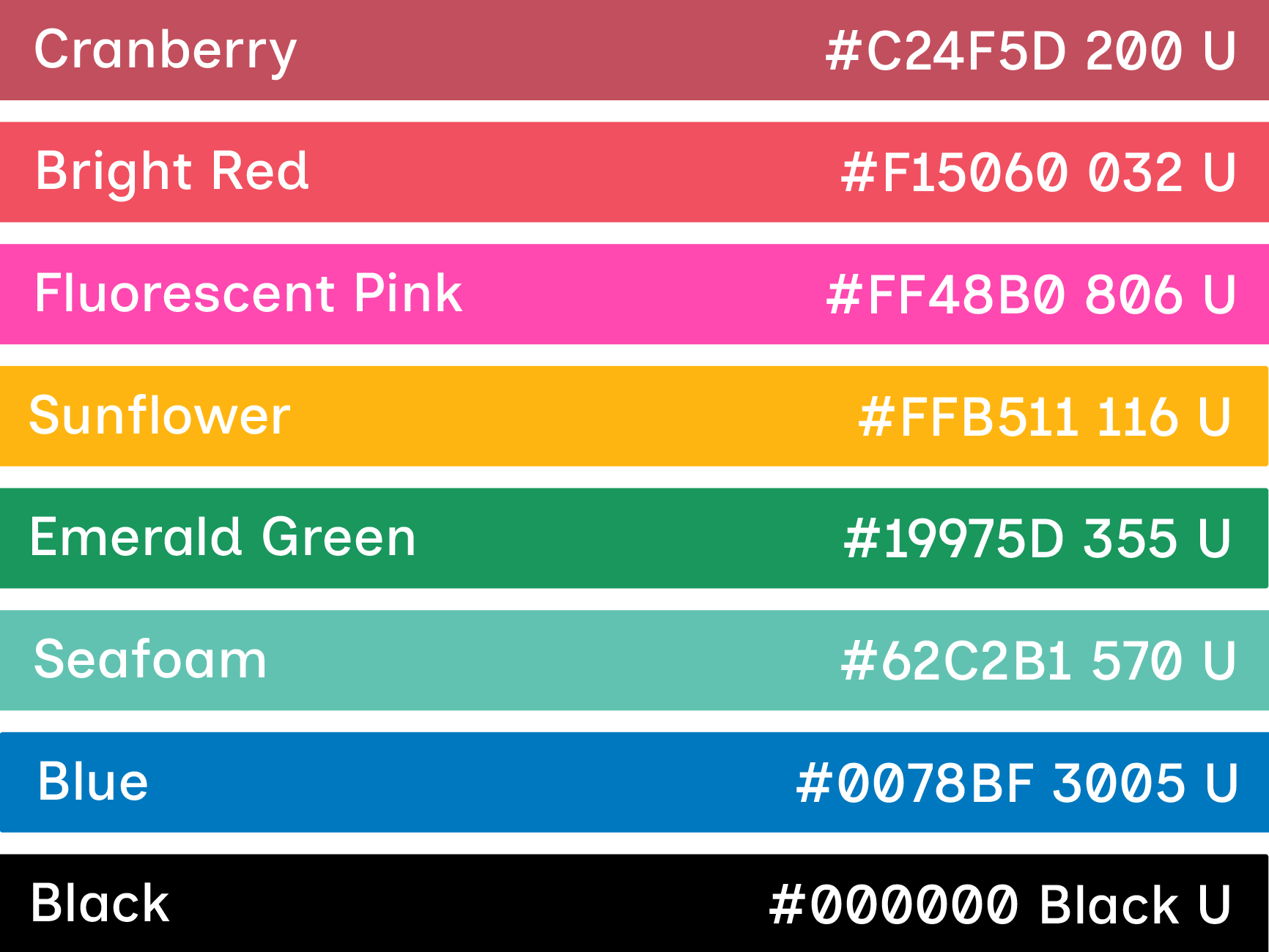
We have 8 colors in our studio, each represented with a hex code and Pantone number below. For more technical information on riso inks (CMYK, RGB codes), please visit the Stencil.Wiki here.
1-Color Print (INK)
2-Color Print (INKS)
3/4-Color Print
Types of Projects
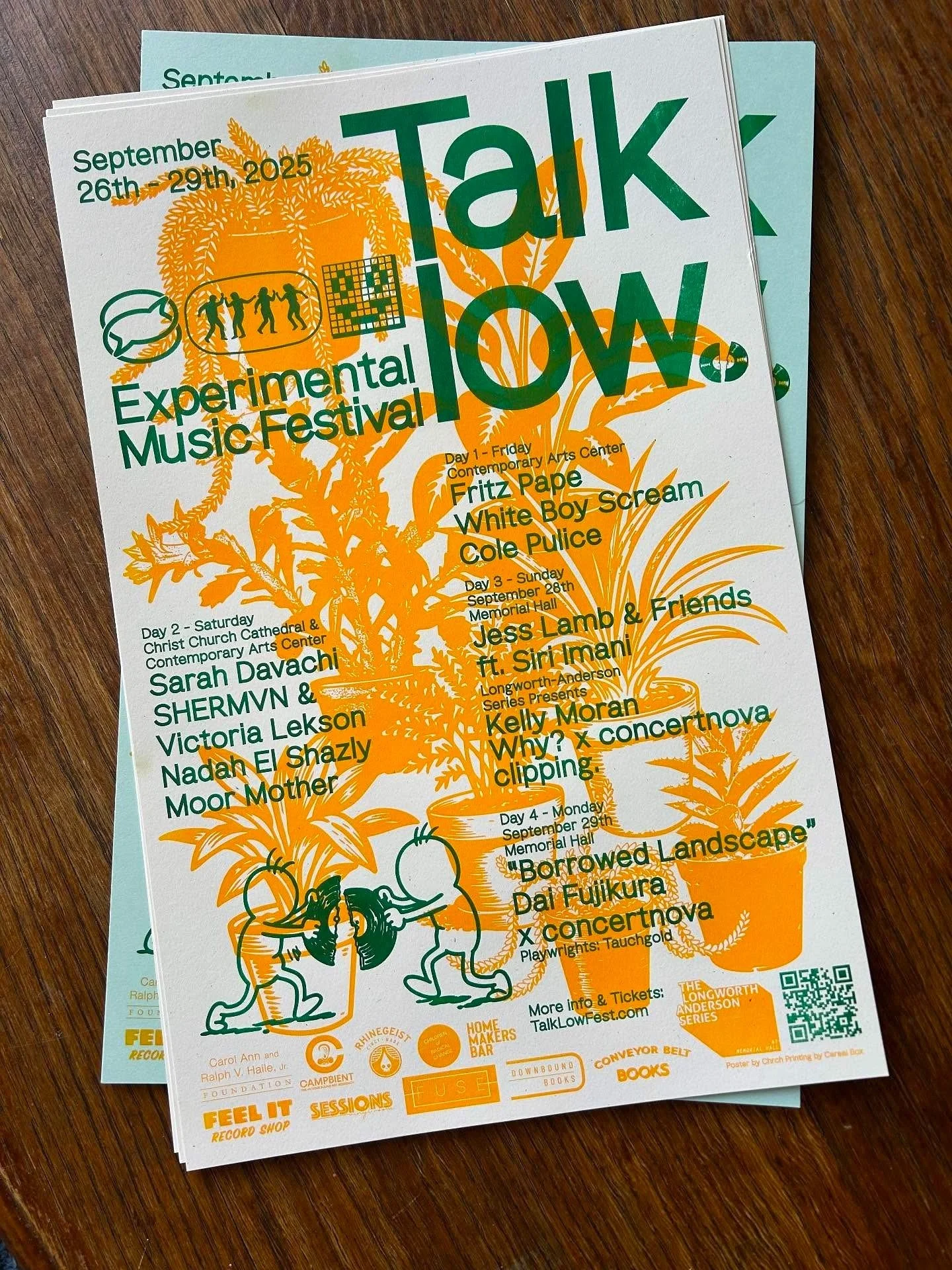
Flat Prints / Posters / Cards / Folded Programs
Stand-alone prints, either flat or folded.
PAPER WEIGHT
20lb Bond - 80lb Cover
PRINT SIZE
11” x 17” is the maximum sheet size we can print on, but 10” x 16” is the max size for a print with full-bleed trim.
FINISHING OPTIONS
Collating (for sets of prints)
Trimming
Corner-Rounding
Folding
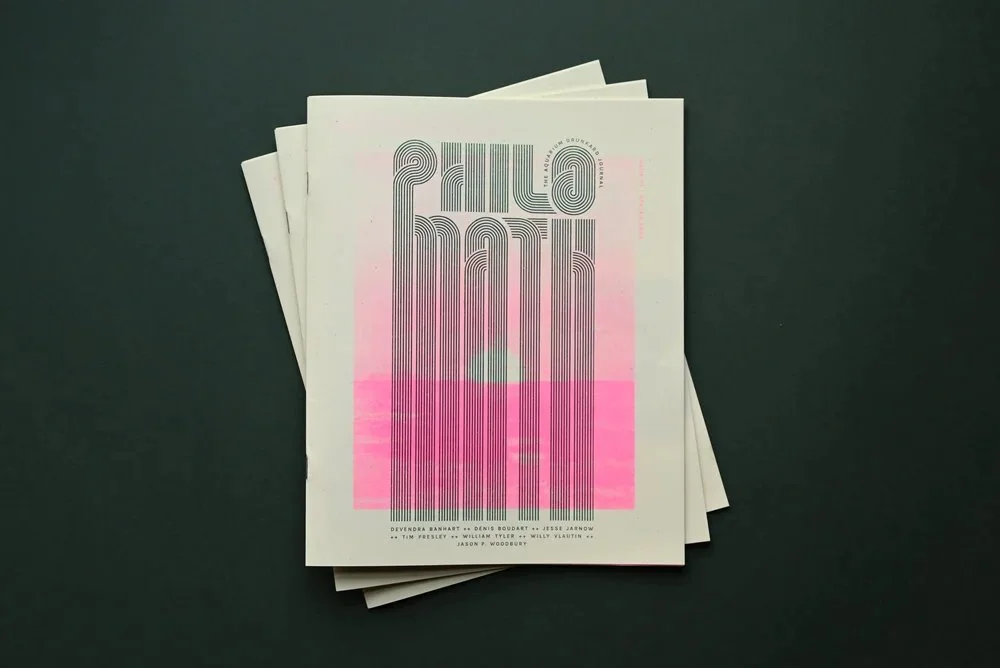
Zines
Multi-page folded prints, bound into a single pamphlet.
PAGE SIZE
Up to 8”x10” with full bleed trim
Up to 8.5”x11” no trim
The most economic option is 5”x8” or smaller, due to the way we gang up pages onto a print sheet.
PAGE COUNT
Page count must be a multiple of 4, because each folded sheet results in 4 pages. For zines, we recommend a max page count of 52. We can hand-sew larger zines, but they feel super bulky. Page count includes front cover, front inside, back inside, and back cover.
BINDING OPTIONS
-Stapled ($)
-Machine Sewn ($$)
-Hand-Sewn ($$$)
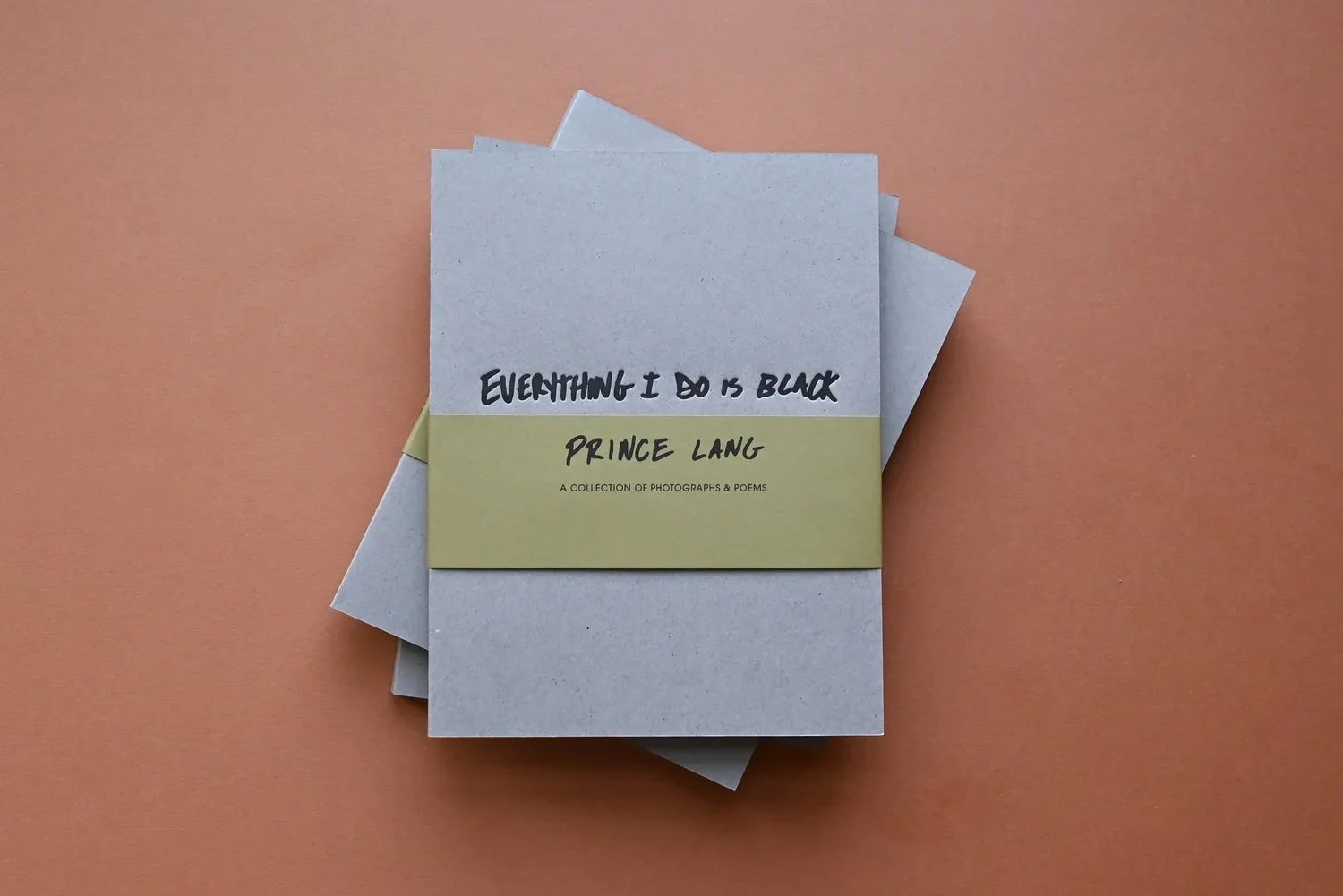
Books
Longer-form printed projects, bound with a spine, or a hole-punching machine (like twin-loop or spiral).
PAGE SIZE
Up to 10”x16” with full bleed trim
Up to 11”x17” no trim
The most economic options are 5”x8” or smaller, then 8”x10” or smaller, due to the way we gang up pages on a print sheet.
PAGE COUNT
Twin-Loop Wire: 100 max
Spiral Bind: 200 max
Hand-bound: case by case
Page count includes front cover, front inside, back inside, and back cover.
BINDING OPTIONS
-Twin-Loop Wire
-Plastic or Wire Spiral
-Custom Hand-Sewn
Design Considerations
-
Consider how many colors, and which colors, you want to print with—we typically recommend no more than 4 colors.
When designing digitally, 100% black will print as 100% opacity in whatever color you choose; adjust shades of color using opacity percentages in your design software. You can separate your colors by layer, and set the blend mode to “multiply” to get an idea of how the colors will appear when printing. We don’t recommending setting the color transparency in your designs to less than 20%, as the print will be barely visible.
In programs like Illustrator or Procreate, people often separate colors by layer. When working with photos, it can be much easier to separate colors by channel. You can also try tools like Spectrolite (it’s free!) to do color separation for you. More on that in File Setup (see below). -
If you want your images or designs to run off the edge of any pages, you need to include at least .125” of bleed in your file. This means your images should not end at the edge of your page, but should end at your bleed lines. Depending on the program you’re using, the bleed lines will look like a thinner line outside of your page edges. We recommend you set the bleed settings before designing, as you set up your file.
-
It’s important to know how your project will be bound as your are designing so that you know what your page count needs to be, and any limitations regarding the margins or spine. If you are using a spiral or twin-loop binding, please keep the inner 1/4” margin (spine edge) of each page clear of important elements. These page edges will be punched through with holes for binding.
-
Because booklets are folded sheets of paper nested inside each other, the inner pages naturally extend slightly beyond the outer ones. This is called page creep. After binding, all pages are trimmed together, which means small shifts in margins can occur.
When designing your booklet, we recommend allowing generous inner and outer margins to ensure important content isn’t trimmed too close to the edge. There is a CREEP setting in InDesign to accommodate for this; let us know if you plan to use it, and we can help you determine how to calculate your adjustment.
Paper
When choosing paper, you have two general categories: Text Weight & Cover Weight (70T is not the same as 70C!). We can work with any un-coated (matte finish, no glossy coatings) paper stock up to 11” x 17” in size, between 50lb Text & 80lb Cover.
50 lb Text (or 50T) ≈ 75–80 gsm
80 lb Cover (or 80C) ≈ 215–220 gsm
BRANDS WE USE OFTEN:
Cougar White / Cougar Natural ($)
Lettermark Colors ($)
Neenah Environments & Astrobrights ($$)
French Paper ($$$)
It is helpful to consider how the paper choice will look in combination with the colors and transparencies in your design. Try including a base layer in your files for paper color, but make sure to turn it off before exporting final files!
If something is getting folded, consider the fact that cheaper paper often cracks when folded, even if it’s scored first. A physical test is the best way to tell, but we often recommend slightly more expensive brands if you want to use 80C for covers. If you have a smaller budget, consider a lighter weight option like Lettermark Vellum Bristol 67lb.
Paper
Paper
Paper
File Setup Guidelines
Each color layer must be saved as a separate black-and-white file (grayscale PDFs). Your files should be a minimum of 300 DPI. If ordering full bleed prints or pages, include at least .125” of bleed for photos or designs running off the edge of the page. When sending print files, please also provide a full-color mockup (PDF or jpeg) so we can see what your design is supposed to look like. When exporting, please include crop marks & bleed (not bleed marks).
For ZINES OR BOOKS, please review notes on binding and creep to make sure you’ve thought through page count, margins, and creep settings before exporting. Also please export your files as pages, not spreads. For example, if you are printing in 2 colors, we should receive 2 black & white PDFs, each with all pages included, ordered front, back, front, back, etc..
If you are comfortable with the design software, but don’t want to worry about exporting PDFs, you can send a packaged Adobe file (InDesign, Photoshop, or Illustrator), or a link to your Canva file. You can also hand us physical paste-up sheets to scan on the scanning bed! Depending on whether your files are in full color or black, we may be able to take it from there, for no extra charge. If the project needs more than 30 minutes of work, we charge $65/hour for file setup time.
Color Separation
Riso printers print one (or two, with a 2-color machine) ink at a time. Similar to silkscreen printing or offset printing, this means that each color in your design must be separated into its own black & white image before printing. The riso printer creates master stencils using these separations. For illustrations and text, people often use layers in Adobe InDesign/ Illustrator to organize their different colors, so you can turn layers on and off to see how things will overlap. For photos or more complex multi-color designs, Channels in the Adobe programs can be much more efficient for color separation, previewing, and exporting.
Opacity differences in your black & white files equate to color value differences, once printed in that color. We recommend most text and important elements are set to 100% opacity, unless you want things to appear lighter or when creating gradients, adjusting opacity creates lighter tones within that color range. We don’t recommend setting anything to lighter than 20% opacity.
Here are some useful color separation links for riso:
Photoshop
InDesign
Illustrator
Procreate
Spectrolite is a risograph-specific app (Mac only) that is super useful for beginners and advanced users alike! And it’s free! It will create color separations from any full-color image, based on which ink colors you have chosen, and will give you usable black and white PDFs to print from. It can also help you mockup different paper colors, or impose pages for printing zine pages 2-up on a larger sheet.
Spectrolite (free app, Mac only)
File Naming
Each color layer must be saved as a separate black-and-white file (greyscale). Please name each file accordingly so we know which file should be printed in which color ink.
ex. (MyProject_BrightRed.pdf, MyProject_FluoPink.pdf)